

WEATHER ALERT
Hurricanes




COUNTY-BY-COUNTY: Sign up for Central Florida emergency alerts
Read full article: COUNTY-BY-COUNTY: Sign up for Central Florida emergency alertsFrom boil water notices to sand bag locations to shelters, emergency alerts are sent out by the county to get important information to its residents — especially during a major storm or hurricane.

COUNTY RESOURCES
BEFORE THE STORM








DURING THE STORM




AFTER THE STORM


Gulf

Atlantic

VIDEO FORECAST


For the North Atlantic, Caribbean Sea and the Gulf of America:
Active Systems: The National Hurricane Center is issuing advisories on Tropical Storm Fay, located several hundred miles southwest of the Azores.
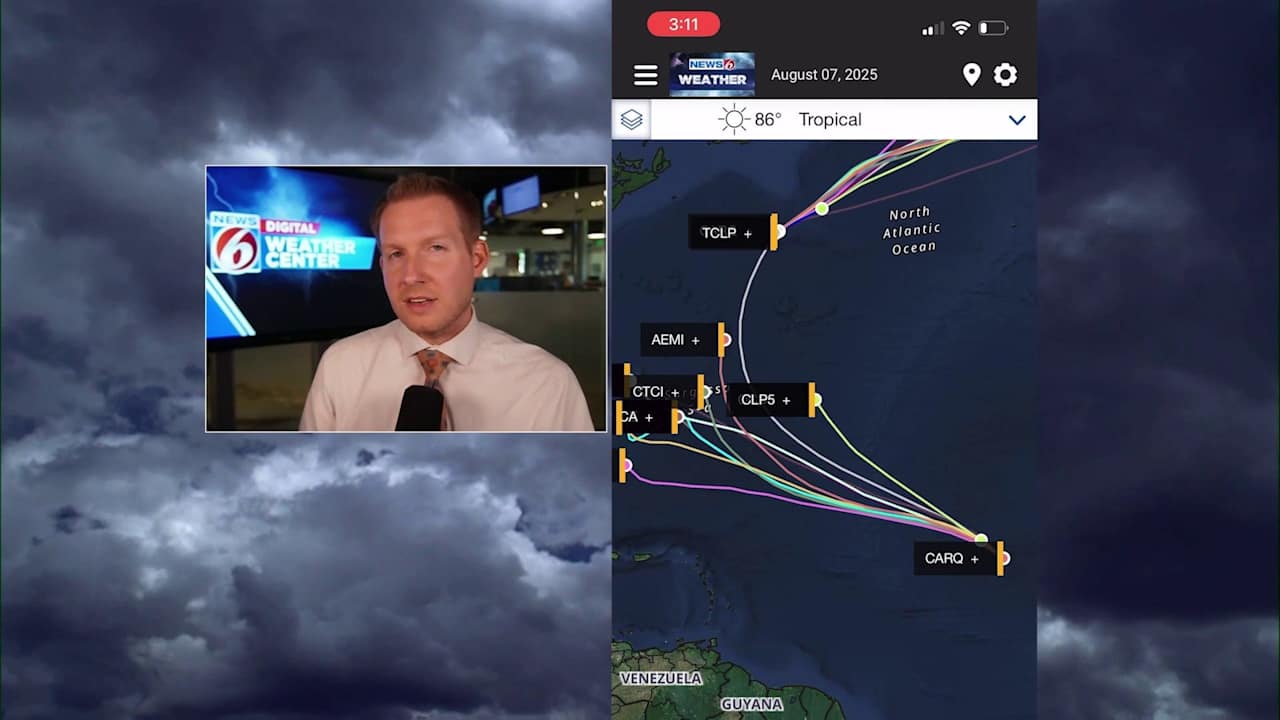
Far Eastern Tropical Atlantic (AL90): Recent satellite-derived wind data indicates that an area of low pressure located less than 200 miles to the south-southeast of the Cabo Verde Islands is producing winds of 40-45 mph to the north of its center, which is gradually becoming better defined. In addition, the system is producing a large area of showers and thunderstorms that are also showing signs of organization. If these current trends continue, the system is likely to become a short-lived tropical storm as soon as later tonight or on Friday while it moves northwestward to northward. Increasing upper-level winds, however, should prevent further development over the weekend. Interests in the Cabo Verde Islands should monitor the progress of this system as gusty winds, areas of heavy rain, and flash flooding are possible over the islands by Friday. Heavy rain and flash flooding could also occur well to the east along the coast of western Africa, particularly in western portions of Senegal, The Gambia, Guinea-Bissau, and southwest portions of Mauritania. * Formation chance through 48 hours, high, 80 percent. * Formation chance through 7 days, high, 80 percent.
Posted 50 minutes ago by NHC Forecaster Forecaster Papin

Special Features
Tropical Storm Fay is centered near 29.8N 41.8W at 24/2100 UTC or 890 nm WSW of the Azores, moving W at 5 kt. Estimated minimum central pressure is 1005 mb. Maximum sustained wind speed is 45 kt with gusts to 55 kt. Peak seas to 12 ft are occurring within 75 nm across the NW semicircle. Numerous strong convection is noted within 90 nm of the center. Some strengthening is possible overnight before weakening likely commences by Fri afternoon. A generally westward motion with some decrease in forward speed is expected over the next few days.
Please read the latest HIGH SEAS FORECAST issued by the National Hurricane Center at website - https://www.nhc.noaa.gov/text/MIAHSFAT2.shtml and the latest Fay NHC Forecast/Advisory and Public Advisory at www.hurricanes.gov for more details.
Far Eastern Tropical Atlantic (AL90): An elongated area of low pressure located a few hundred miles south-southeast of the Cabo Verde Islands is producing a large area of disorganized showers and thunderstorms. This system could become a short-lived tropical depression or tropical storm later today or on Friday while it moves northwestward to northward. Increasing upper-level winds, however, should prevent further development over the weekend. Interests in the Cabo Verde Islands should monitor the progress of this system as gusty winds, areas of heavy rain, and flash flooding are possible over the islands by Friday. Heavy rain and flash flooding could also occur well to the east along the coast of western Africa, particularly in western portions of Senegal, The Gambia, Guinea-Bissau, and southwest portions of Mauritania. This system has a high chance of formation in the next 48 hours.
Heavy Rainfall in Central America and Southern Mexico: A mid to upper- level trough currently extends from the eastern Gulf of America across the Yucatan Peninsula and NW Caribbean, while relatively warm sea surface temperatures and abundant low level moisture are present. An elongated low level trough will prevail across this area during the next several days, and aid in funneling enhanced tropical moisture across Central America and the western Caribbean, supporting periods of heavy rainfall through Sat the 26th. There is still some uncertainty regarding the exact location of heaviest rainfall, but for now heavy rainfall looks likely across extreme southeastern Mexico near Chiapas, southern and central Guatemala, western Honduras, El Salvador, southern and eastern Belize, as well as across portions of Costa Rica and Panama. Currently, numerous showers and isolated thunderstorms extends from the Gulf of Honduras, north- northeastward across the Cayman Islands and into the southern coastal waters of Cuba. Heavy rainfall across these regions will create the possibility of life- threatening flash flooding and landslides. Please refer to local weather services as well as the International Desk at the Weather Prediction Center for more information.
Tropical Waves
A central Atlantic tropical wave is analyzed along 49W, S of 14W, moving west at around 15 kt. Scattered moderate convection is noted from 10N to 13N between the wave axis and 51W.
An eastern Caribbean tropical wave is along 69W, south of 13N into western Venezuela, moving westward at 15 kt. No significant convection is depicted over waters in association with this wave.
Monsoon Trough/ITCZ
The monsoon trough enters the E Atlantic near 16N17W and extends SW to near 12N35W. The ITCZ extends from 10N42W to 10N50W. Scattered moderate convection is noted from 05N to 09N between 28W and 35W.
Gulf Of America
A stationary front extends from SW Florida to the upper Texas coast. N of the boundary, moderate to locally fresh NE winds and 2 to 4 ft seas prevail. To the south, gentle winds and 1 to 3 ft seas dominate.
For the forecast, the stationary front will begin to move E as a cold front and progress through the basin through Fri, then stall again over the SE Gulf this weekend. Moderate to locally fresh winds will follow the front through Fri night. Elsewhere, gentle to moderate winds will prevail through Sat night. Winds will diminish slightly Sun into early next week.
Caribbean Sea
Please see Special Features section above for information on upper-level low pressure across the far western Caribbean that is expected to produce areas of heavy rainfall over portions of Central America into the weekend.
At the surface, high pressure across the central Atlantic extends a weak ridge north of the area.Fresh trades prevail across most of the basin S of 15N and E of 80W. Seas in these winds are 4 to 7 ft. Over the eastern Caribbean moderate winds prevail along and 3 to 5 ft in the moderate winds. Elsewhere, light to gentle winds and slight seas prevail.
For the forecast, the pressure gradient will generate moderate to fresh trades over the S central Caribbean, and gentle to moderate winds elsewhere. An upper-level trough will support scattered to numerous showers and thunderstorms over the W Caribbean for the next couple of days.
Atlantic Ocean
See Special Features section above for information on Tropical Storm Fay.
A mid- and upper-level trough and associated surface boundaries extending from offshore North Carolina to the Florida Straits is generating numerous moderate convection W of 70W. The most dominant frontal boundary extends from 31N72W to South Florida. N of this boundary, fresh to strong N to NE winds and rough seas are increasing. Ahead of the front, north of 28N and between 71W and 73W moderate S to SW winds prevail.
Another upper-level low is drifting westward near 25N53W. This feature is interacting with a surface trough resulting in an area of scattered moderate convection from 21N to 28N between 50W and 56W. Outside of this convection, a weak pressure gradient continues across much of the Atlantic, as high pressure remains centered across the far NE Atlantic offshore of Europe. This pattern is sustaining gentle to moderate trades S of 20N and variable light to gentle winds elsewhere W of 35W. However, swell generated from Tropical Storm Fay is producing seas of 6 to 11 ft N of 28N between 38W and 45W.
For the forecast west of 55W, the aforementioned frontal boundary will shift eastward, reaching from near Bermuda to the Straits of Florida Sat night before starting to weaken. Scattered showers and isolated thunderstorms are expected along the frontal boundary. Fresh to strong winds and increasing seas will follow the front through Fri, before decreasing on Sat.
Posted 35 minutes ago by NHC Forecaster Konarik

